
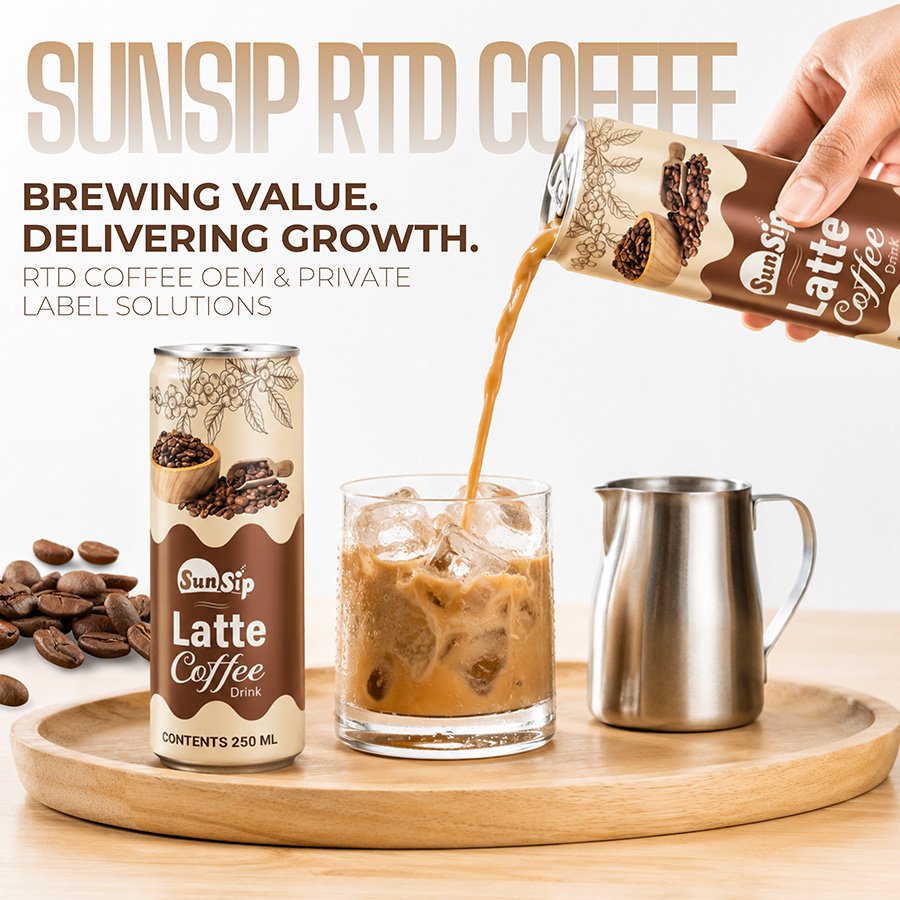
The ready-to-drink (RTD) coffee market is experiencing explosive growth worldwide, and Vietnam is rapidly emerging as one of the most sought-after destinations for brands looking to develop their own private label RTD coffee through OEM manufacturing. With an abundant supply of world-class coffee, competitive production costs, and a proven track record in global export, “RTD Coffee OEM Vietnam” has moved from niche concept to mainstream strategy for international importers, distributors, and beverage brands alike.
This article breaks down exactly why Vietnam has become a top-tier RTD coffee manufacturing hub, what the OEM and private label process looks like in practice, and why now is the right time for your brand to tap into this opportunity.
What Is RTD Coffee and Why Is Demand Surging?
Ready-to-drink coffee refers to fully prepared, pre-packaged coffee beverages that consumers can enjoy immediately — no brewing, no mixing, no effort. Sold in cans, bottles, or cartons, RTD coffee sits at the intersection of convenience and quality, making it one of the fastest-growing categories in the global beverage industry.
Several key factors are driving this surge in demand:
Modern consumers, particularly millennials and Gen Z, prioritize speed and convenience without compromising on taste. As the global iced coffee and milk coffee trend continues to sweep from Asia into Western markets, the appetite for RTD coffee variants — latte, cappuccino, mocha, vanilla, espresso — has never been stronger. Meanwhile, the expansion of modern retail channels such as convenience stores, supermarkets, and e-commerce platforms has dramatically increased product accessibility, putting RTD coffee within arm’s reach of billions of consumers.
For brand owners and importers, this creates a compelling opportunity. Rather than investing in manufacturing infrastructure, R&D facilities, and supply chain logistics from scratch, partnering with an experienced RTD coffee OEM manufacturer allows brands to go to market faster, smarter, and at a fraction of the cost.
Why Vietnam? The Case for RTD Coffee OEM Manufacturing in Vietnam
1. World-Class Coffee at the Source
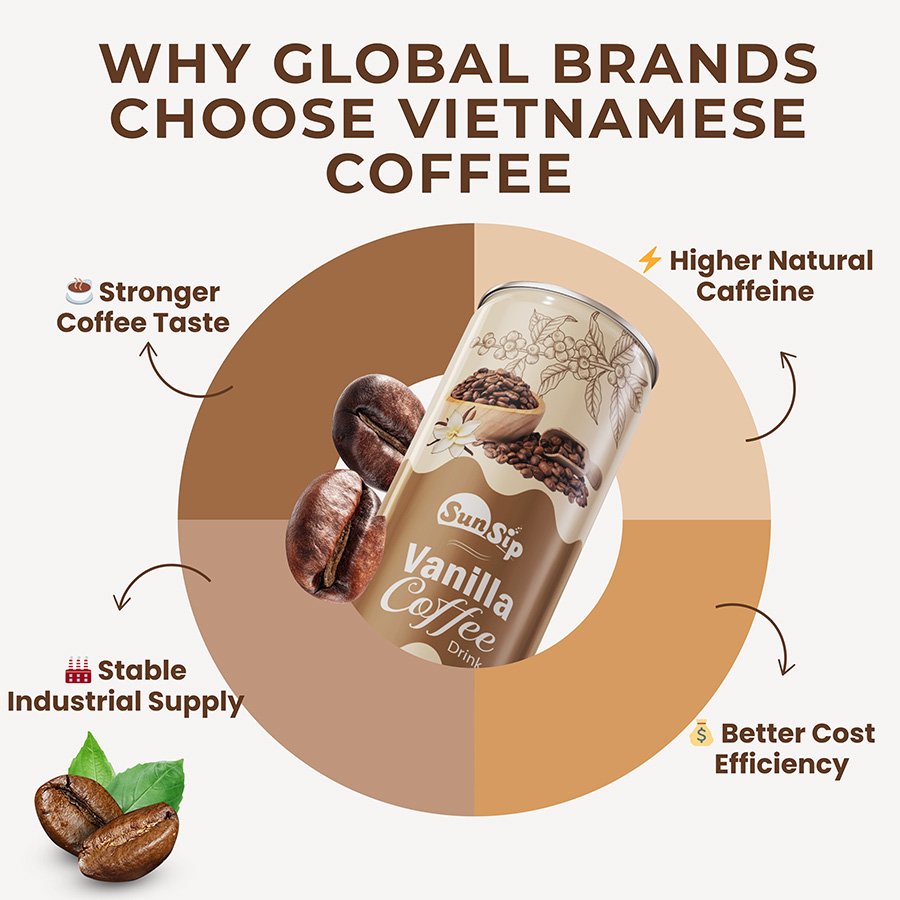
Vietnam is the world’s largest producer and exporter of Robusta coffee and also cultivates premium Arabica beans in highland regions such as Lam Dong and Son La. This gives Vietnamese RTD coffee manufacturers a fundamental advantage: direct access to high-quality raw material at source pricing.
For OEM partners, this translates into:
Lower input costs compared to manufacturers who must import coffee beans from third-party origins. Greater traceability and quality control throughout the supply chain, from farm to finished can. The ability to blend different coffee varieties to achieve the precise flavor profile your brand requires.
2. Stronger Coffee Taste and Higher Natural Caffeine
Vietnamese Robusta coffee is internationally recognized for its bold, rich flavor and higher natural caffeine content compared to most Arabica varieties. This characteristic makes it an exceptional base for RTD coffee products that need to deliver a genuine, satisfying coffee experience in a can.
For consumers who have grown accustomed to watered-down RTD coffee options on the market, a product built on Vietnamese Robusta immediately stands out — offering a stronger taste, a more robust aroma, and a more effective caffeine kick. This is a powerful differentiator that brands can leverage in their product positioning and marketing communications.
3. Stable Industrial Supply Capacity
Vietnam’s food and beverage manufacturing sector has undergone significant development over the past decade. Modern production facilities operating under internationally recognized quality standards — including HACCP, ISO 22000, and FDA compliance for exports to the United States — are now well-established across the country.
For OEM partners placing large-volume orders, this means:
Consistent production capacity capable of fulfilling container-scale orders reliably. Rigorous quality control processes applied at every stage — raw material inspection, production, filling, sealing, and packaging. Stable supply chains that minimize the risk of disruption, a critical factor for international brands managing long replenishment cycles.
4. Better Cost Efficiency
Compared to sourcing RTD coffee production from countries with higher labor and operational costs — such as South Korea, Japan, or Western Europe — Vietnam offers a compelling cost advantage without compromising on quality. The combination of locally sourced raw materials, competitive manufacturing costs, and well-established export logistics makes Vietnam-origin RTD coffee exceptionally cost-efficient for international buyers.
This directly supports healthier margins when products are distributed through retail networks overseas, allowing brands to price competitively while maintaining profitability.
Vietnam Coffee Export Growth: The Numbers That Tell the Story
The trajectory of Vietnam’s coffee export performance over recent years speaks for itself:
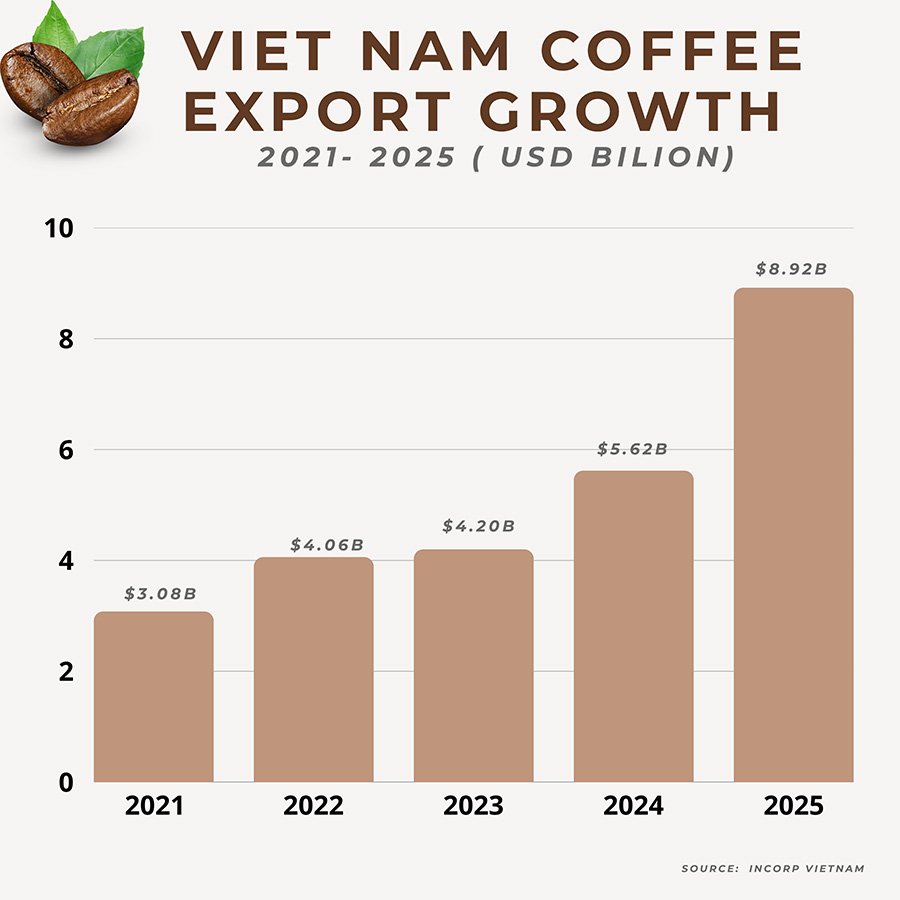
In 2021, Vietnam’s total coffee export value reached USD 3.08 billion. By 2022, this figure climbed to USD 4.06 billion, reflecting rising global demand. 2023 saw continued growth at USD 4.20 billion. A significant acceleration occurred in 2024, with exports reaching USD 5.62 billion. And 2025 is projected to reach a record-breaking USD 8.92 billion in coffee export value.
This near-tripling of export value over just five years is not accidental. It reflects the deepening integration of Vietnamese coffee into global supply chains, the growing recognition of Vietnamese coffee quality among international buyers, and the increasing sophistication of Vietnamese manufacturers in delivering value-added coffee products — of which RTD coffee is among the highest-potential segments.
For OEM and private label partners, these figures signal a stable and expanding supply ecosystem. As export volumes grow, so does the underlying infrastructure: logistics, packaging, cold chain management, and compliance expertise. Partnering with a Vietnamese RTD coffee manufacturer today means plugging into a system that is actively scaling to meet global demand.
The Full Flavor Range: Meeting Every Market Preference
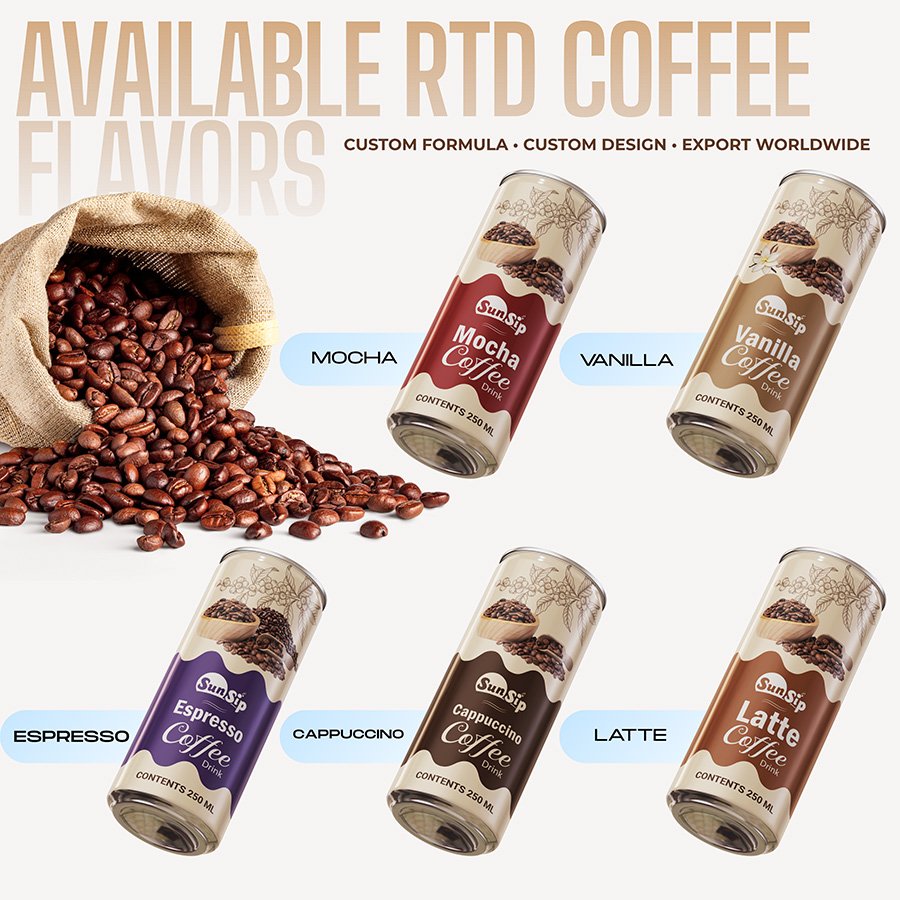
One of the most practical advantages of working with a Vietnamese RTD coffee OEM manufacturer is access to a ready portfolio of proven flavor variants, each developed to appeal to different consumer segments and market tastes. A typical offering covers five core flavors across the 250ml aluminum can format:
Latte Coffee is the most universally popular RTD coffee variant — a smooth, balanced blend of coffee and milk that appeals to a broad consumer base. It is the ideal entry point for brands entering new markets or targeting first-time RTD coffee consumers.
Mocha Coffee combines the depth of espresso with the richness of chocolate, delivering a more indulgent, dessert-like experience. This flavor consistently performs well among younger consumers and those who enjoy sweetened coffee beverages.
Vanilla Coffee offers a lighter, more aromatic profile with the delicate sweetness of vanilla complementing the coffee base. It is particularly popular among female consumers and those who prefer a gentler coffee experience.
Espresso Coffee is positioned for the purist — a concentrated, bold coffee with minimal sweetening, delivering maximum caffeine impact. This variant resonates strongly in markets with established espresso culture, including Southern Europe and parts of Southeast Asia.
Cappuccino Coffee strikes an elegant balance between espresso strength and milk creaminess, replicating the café experience in a convenient can format. It is a staple flavor in Western markets and increasingly popular across Asia as café culture continues to grow.
Having access to this full flavor range allows brand partners to launch a single hero SKU or build a complete RTD coffee lineup that covers multiple consumer occasions and preferences under one cohesive brand identity.
How the OEM & Private Label Process Works
For brands new to the OEM manufacturing model, the process of developing a custom RTD coffee product in Vietnam is more straightforward than most expect. A typical engagement follows these key stages:
Needs Assessment and Brief — The process begins with a detailed discussion of the partner’s requirements: target market, flavor preferences, desired caffeine level, sugar content, can size, annual volume forecast, and any specific regulatory requirements for the destination country.
Formula Development and Sampling — The manufacturer’s R&D team develops a custom formula based on the brief and produces samples for evaluation. Partners can request multiple iterations until the taste, aroma, and texture meet their exact specifications before committing to full-scale production.
Packaging Design and Label Compliance — Once the formula is approved, the focus shifts to the can design and labeling. The manufacturer works with the partner’s design team — or provides in-house design support — to create packaging that reflects the brand identity while meeting the regulatory labeling standards of the target market.
Production and Quality Control — With both formula and design signed off, production begins. Quality checks are conducted throughout the manufacturing process, from incoming material inspection to final product testing before shipment.
Export Documentation and Logistics — The manufacturer prepares all necessary export documentation — certificates of analysis, health certificates, packing lists, and customs declarations — ensuring a smooth clearance process at the destination port.
The minimum order quantity (MOQ) and lead time will vary by manufacturer and order complexity, but most established Vietnamese RTD coffee OEM producers offer flexible terms for first-time partners to reduce initial risk.
Why This Moment Is the Right Time to Act
The global RTD coffee market is still in a high-growth phase, and the brands that establish their private label products now will have first-mover advantage in their respective markets as the category matures. Vietnam’s coffee export momentum — heading toward nearly USD 9 billion in 2025 — reflects a manufacturing ecosystem that is not only capable of meeting current demand but is actively investing in the capacity to scale further.
For importers, distributors, and brand owners, the combination of high-quality Vietnamese Robusta coffee, competitive OEM production costs, diverse flavor options, and reliable export capability creates an ideal foundation for launching or expanding an RTD coffee product line.
The question is no longer whether to source RTD coffee from Vietnam — it’s which partner to choose and how quickly to move.
Ready to Brew Your Own Brand?
If your business is exploring RTD coffee OEM or private label manufacturing in Vietnam — whether you’re launching a new brand, expanding an existing portfolio, or looking to replace your current supplier — the opportunity to develop a custom formula, custom design, and globally export-ready product is well within reach.
Connect with a trusted Vietnamese RTD coffee manufacturer today to discuss your requirements, request product samples, and explore a partnership built on quality, consistency, and shared growth.
Brewing Value. Delivering Growth.