
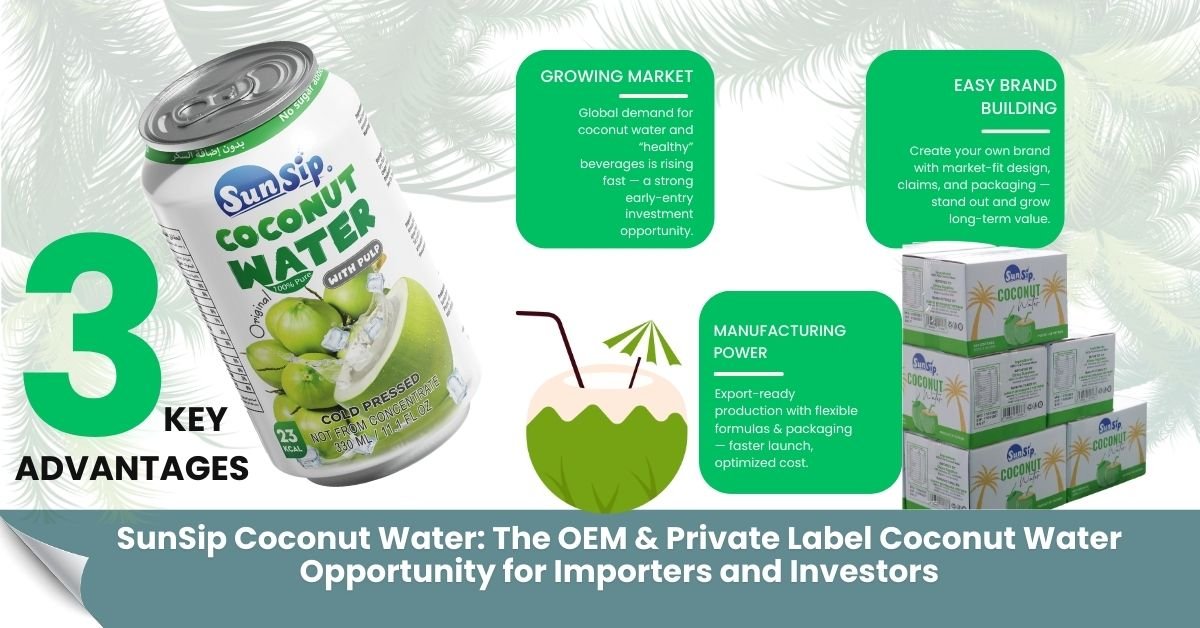
Coconut water has shifted from a niche “healthy drink” to a mainstream, high-growth category across global markets. Consumers are actively choosing beverages that feel clean, natural, and functional—especially products that support hydration in a simple, everyday way. For importers, distributors, and investors, coconut water stands out because it meets three powerful demands at once: wellness positioning, broad demographic appeal, and strong repeat purchase potential.
If you are looking to scale a beverage portfolio or launch a new brand with stable long-term value, SunSip Coconut Water offers a practical path forward—through OEM manufacturing and private label coconut water solutions designed for export markets. This blog explains why coconut water is a strategic category, how to build a winning product line, and how SunSip can support your growth from production to branding.
Why Coconut Water Is a Smart Beverage Category to Invest In
1) “Better hydration” is a daily habit, not a seasonal trend
Unlike many beverage categories that spike only around holidays or special occasions, coconut water fits into daily life: commuting, gym, school lunch, office desk, and family shopping baskets. Consumers don’t need to “learn” how to drink it—coconut water’s value proposition is simple: refreshing hydration with a natural image.
That daily habit matters for B2B buyers. A category that sells steadily creates predictable restocking cycles for retailers and stable demand for distributors. When you build your brand in a consistent, everyday category, you can scale more smoothly and plan inventory with confidence.
2) Coconut water speaks to multiple consumer segments
A strong importer strategy depends on serving more than one segment. Coconut water allows that:
-
Fitness & active lifestyle: hydration, recovery, and “clean energy” associations
-
Health-conscious families: natural beverage alternative to sugary drinks
-
Young adults: lifestyle positioning, convenience, and trendy packaging formats
-
Premium buyers: minimal ingredient lists and quality-focused messaging
This broad consumer base helps distributors grow across channels (modern trade, convenience, HORECA, gyms, and online) without being locked into a single niche.
3) It supports premium pricing and brand storytelling
Coconut water is a category where consumers often accept value-based pricing—especially when the brand communicates quality, origin, and authenticity. With the right packaging, brand design, and claims (market-compliant), your product can occupy a premium shelf position and build long-term brand equity.
The B2B Advantage: OEM & Private Label Coconut Water
For many importers and investors, the fastest way to win is not to compete with existing brands head-to-head immediately—but to create a brand tailored to your market, price tier, and distribution strengths. That’s where OEM coconut water and private label coconut water become strategic.
What OEM Coconut Water means for your business
An OEM manufacturer produces the product based on your specifications. You can choose:
-
Packaging format (can, PET, glass, etc.)
-
Taste direction (classic, lightly sweetened where allowed, flavored variants)
-
Label style and brand positioning
-
Carton design, palletization, and export documentation support
For importers, OEM reduces development risk and speeds up your time to market. For investors, it creates a scalable brand asset without requiring you to own a factory.
What Private Label Coconut Water means
Private label is ideal when you want a fast launch under your own brand or retail brand—often with standardized specifications. You focus on distribution and sales while the manufacturer ensures production consistency and export-readiness.
Both approaches work well in coconut water because the product concept is easy to communicate, but the market still leaves room for brands that are localized and channel-smart.
SunSip Coconut Water: Built for Export Markets
SunSip Beverages Vietnam develops beverage solutions for global partners—especially those seeking scalable OEM/private label capacity. When working with an export-oriented manufacturer, B2B buyers usually care about three things: reliability, flexibility, and consistency.
1) Export-ready production mindset
International buyers need a supplier who understands export operations: lead time discipline, packaging durability for long-distance shipping, clear documentation, and stable quality standards. Export success depends on details—carton strength, pallet configuration, container loading, and consistent labeling compliance.
2) Packaging formats that match your market
Different regions win with different pack sizes and formats. A good coconut water manufacturer should support a flexible packaging strategy so you can fit modern trade, convenience, and on-the-go consumption.
Common winning formats include:
-
330ml can for convenience stores, gyms, and impulse purchase
-
500ml PET for daily hydration, office and family
-
1L family pack for home consumption and value shoppers
(Your final selection depends on target pricing, distribution channel, and local regulations.)
3) A product line strategy, not just a single SKU
One SKU can open doors, but a product line grows your brand and increases shelf space. The strongest distributors in coconut water often use a staged approach:
-
Start with a hero SKU (most universal)
-
Add a second SKU for a new channel (value or premium)
-
Expand into line extensions after brand trust is established
SunSip can support you through that growth path with OEM/private label flexibility.
Market Strategy: How Importers Win with Coconut Water
Launching coconut water successfully is not only about having a product—it’s about controlling three levers: channel, price tier, and brand positioning.
1) Choose the channel that matches your advantage
-
Modern trade (supermarkets): needs strong packaging and brand presence
-
Convenience stores: favors smaller formats, strong impulse design
-
HORECA: often needs competitive pricing and consistent supply
-
Gyms/fitness channels: premium positioning and functional language
-
Online: storytelling, bundles, and subscription-like repeat behavior
The best OEM/private label strategy is to pick your strongest channel first, then expand once you’ve proven velocity.
2) Decide your price tier: value, mainstream, or premium
Coconut water can succeed in multiple tiers. The key is clarity:
-
Value: focuses on affordability and volume
-
Mainstream: balances quality + price + availability
-
Premium: design-led, origin story, “clean label” emphasis
Your manufacturer should help you keep consistency within your chosen tier—because inconsistent pricing confuses buyers and weakens brand equity.
3) Build brand trust with simple, credible messaging
Consumers buy coconut water because they want something that feels natural and refreshing. Your brand story should be clear and repeatable:
-
“Refreshing hydration for everyday life”
-
“Simple ingredients, clean taste”
-
“A natural alternative to sugary drinks”
Claims must always be adapted to your local regulations. The goal is credibility and consistency—not exaggerated promises.
Branding: Turning Coconut Water Into a Long-Term Asset
Your third pillar—brand—is where investors see long-term value. A product can sell; a brand can scale.
Brand assets that matter in coconut water
-
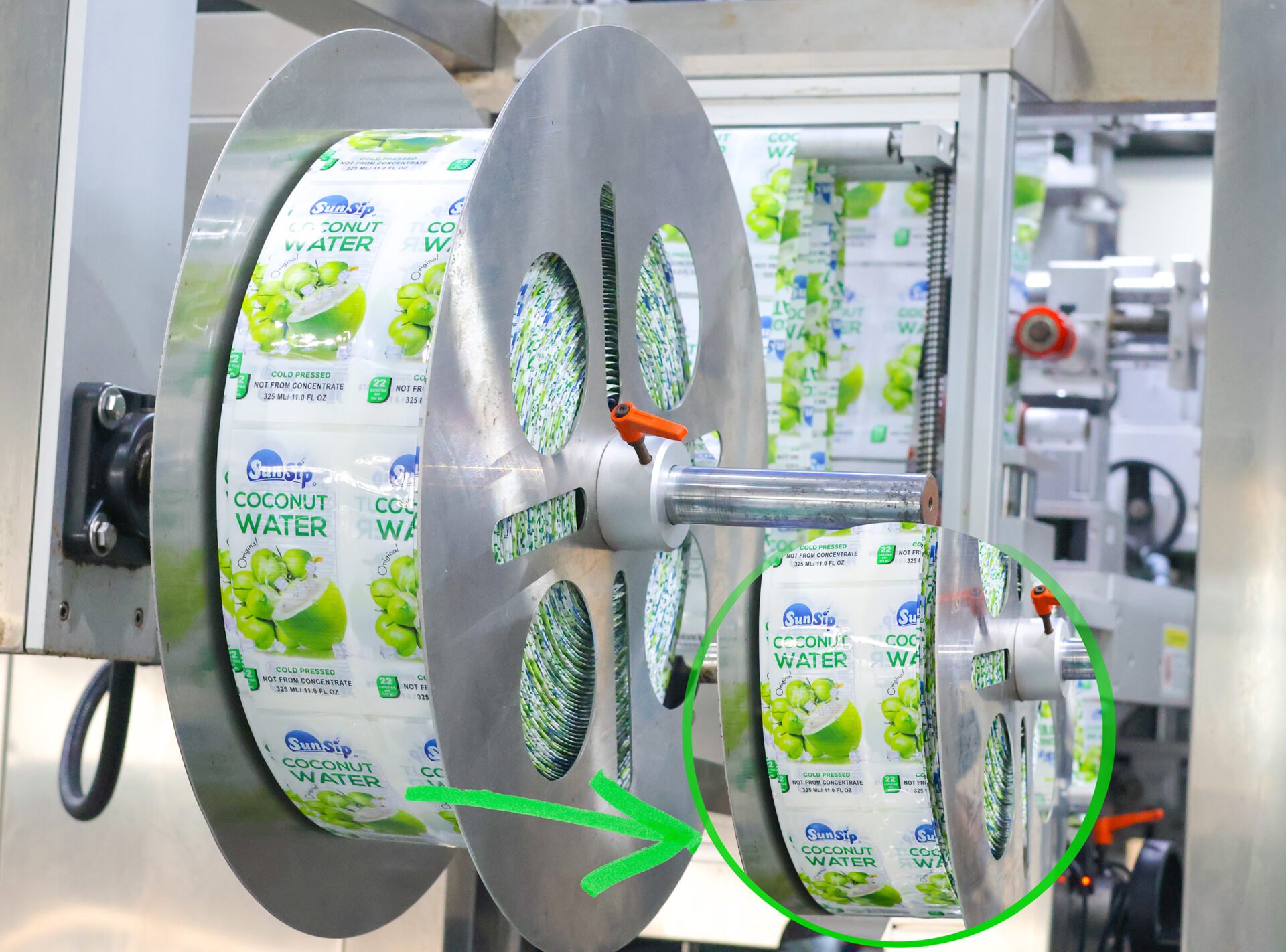
Recognizable design system
Coconut water competes on shelf. Strong color system, readable typography, and a consistent layout improve repeat purchase. -
A clear “hero message”
Customers should understand the product in 2 seconds: coconut water, refreshing, easy to drink, good daily choice. -
A portfolio structure that invites line expansion
Even if you start with one SKU, design your packaging system so additional SKUs look like a family. -
Channel-ready marketing
For distributors, it helps when the supplier can provide assets: product images, specs, posters, catalog pages, and social media-ready visuals.
SunSip Coconut Water can be positioned as:
-
A mainstream daily hydration brand
-
A premium clean-label brand
-
A value family pack brand
depending on your market strategy.
Product Development Roadmap for Importers & Investors
If you are planning to enter coconut water through OEM/private label manufacturing, here is a simple roadmap used by many successful partners:
Step 1: Define your target consumer and channel
-
Who buys first—families, gym-goers, office workers, students?
-
Where do they buy—supermarket, convenience, online, HORECA?
Step 2: Choose packaging that fits purchase behavior
-
Impulse = smaller size, strong design
-
Daily routine = mid-size, convenient grip
-
Home use = family pack
Step 3: Confirm compliance and labeling requirements
-
Ingredient list format
-
Nutrition panel requirements
-
Language and claim rules
-
Import regulations for your country
Step 4: Launch with a hero SKU and a simple go-to-market plan
-
Sampling strategy
-
Introductory bundles
-
Retail display support
-
Distributor training materials
Step 5: Expand with line extensions
Once velocity is proven, add:
-
Another format for a new channel
-
A premium edition
-
A value pack
-
Market-specific flavor direction (where suitable)
Why Vietnam for Coconut Water Manufacturing?
Vietnam is one of the world’s recognized regions for coconut cultivation and coconut-based products. For global buyers, sourcing from Vietnam can create advantages in supply chain scale and product development expertise. More importantly, working with a specialized beverage manufacturer helps you turn raw-material strength into a retail-ready product—packaged, branded, documented, and export-prepared.
SunSip Beverages Vietnam focuses on converting that origin advantage into a reliable B2B partnership: production coordination, packaging execution, and export mindset—so you can focus on distribution growth.
FAQ: OEM & Private Label Coconut Water (For Importers)
1) Can I launch a coconut water brand under my own label?
Yes. With private label coconut water, you can create your own brand identity and packaging while SunSip produces according to agreed specifications.
2) What is the typical minimum order (MOQ)?
MOQ can depend on packaging format and volume. Many export projects are planned around container-based logistics to optimize shipping cost per unit. (You can request a specific MOQ proposal for your target format.)
3) Can SunSip support multiple SKUs?
Yes. A scalable coconut water strategy often includes multiple pack sizes or formats to serve different channels.
4) How do we start the cooperation process?
Typically, you share target market, preferred packaging format, and desired positioning. SunSip then recommends product specs, packaging options, and an export plan aligned to your channel strategy.
5) Do you provide marketing materials for distributors?
A strong OEM/private label partner should be able to provide product images, catalog-ready specs, and basic promotional assets to support importer launch.
Conclusion: Build Your Coconut Water Business With SunSip
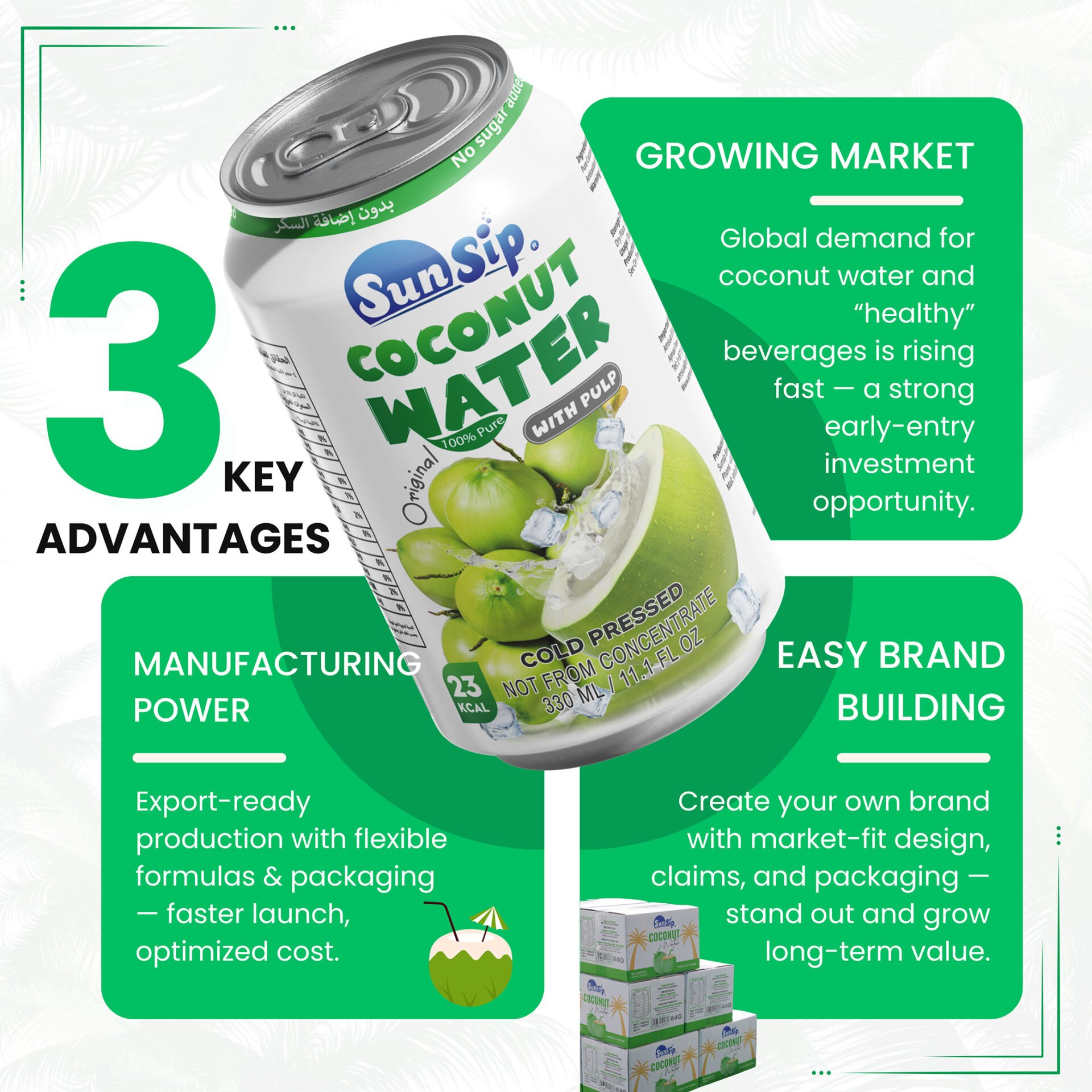
Coconut water is more than a trending drink—it’s a category with daily demand, wide consumer reach, and strong potential for long-term brand value. For importers and investors, the best strategy is to combine three pillars:
-
Market: Enter a growing global hydration category
-
Manufacturing: Work with an export-ready OEM/private label producer
-
Branding: Build a recognizable product line that can scale
SunSip Coconut Water gives you a clear route to launch and grow—whether you are expanding your distributor portfolio or investing in a new beverage brand for your market.
Want the SunSip Coconut Water catalog + quotation?
Send us your target country, preferred packaging (330ml can / 500ml / 1L), and expected order volume. We’ll recommend the best product line strategy for your distribution channel.