
In international trade, shipping terms fob vs cif like FOB (Free on Board) and CIF (Cost, Insurance & Freight) play a crucial role in determining costs, risk, and overall profitability. Choosing the right Incoterm can save you money, give you better control, and ensure smoother import operations.
Vietnam’s food and beverage (F&B) export industry has been growing rapidly, becoming one of Asia’s leading sources of high-quality beverages. Products such as fruit juices, coconut water, aloe vera drinks, energy drinks, and bottled beverages are reaching markets across the Middle East, Africa, Asia, and Europe.
Sunsip Beverages Vietnam – a trusted beverage manufacturer and exporter – primarily offers FOB pricing, giving buyers more flexibility and cost advantages.
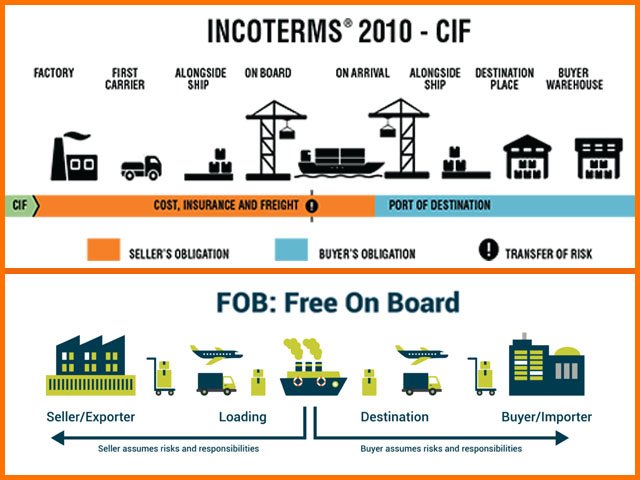
1. Understanding FOB vs CIF
FOB – Free on Board
- Seller responsibilities:
- Manufacture and pack the goods
- Transport to the port of shipment
- Export customs clearance
- Loading goods onto the vessel
- Buyer responsibilities:
- Sea freight
- Insurance
- Destination port charges and inland delivery
- Import customs and duties
Risk transfer: Once goods pass the ship’s rail, the buyer assumes full responsibility.
Benefits: FOB allows buyers to control freight costs, choose carriers, and optimize logistics.
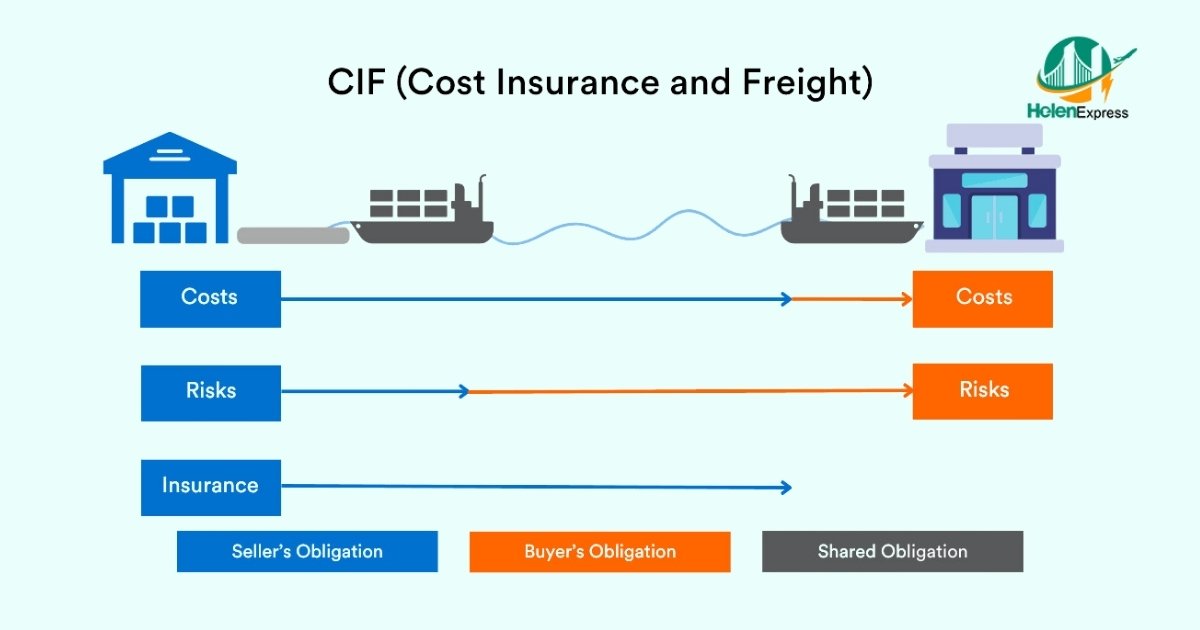
CIF – Cost, Insurance & Freight
- Seller responsibilities:
- Cover shipping costs to the destination port
- Purchase insurance for the shipment
- Handle export documentation
- Buyer responsibilities:
- Destination port charges
- Import clearance, duties, and inland transportation
Risk transfer: Same as FOB — once goods are on board, risk passes to the buyer.
Benefits: CIF is convenient for new importers without logistics support, as the seller handles major transportation steps.
2. FOB vs CIF: Key Differences
| Criteria | FOB | CIF |
|---|---|---|
| Shipping control | Buyer chooses carrier | Seller chooses carrier |
| Insurance | Buyer arranges | Seller arranges |
| Cost | Usually lower | Higher due to shipping & insurance included |
| Risk transfer | On board vessel | On board vessel |
| Transparency | High | Medium, potential hidden fees |
➡ FOB is ideal for experienced importers and large-volume buyers seeking cost efficiency.
3. Why FOB Works Best for F&B Export from Vietnam
The beverage export market has unique requirements:
- Large-volume shipments
- Frequent deliveries
- Cost-sensitive products
FOB advantages for buyers:
- Lower shipping costs: Buyers negotiate freight independently
- Control over insurance: Choose coverage suitable for beverages
- Clear pricing: Transparent product costs
- Flexibility: Ship to multiple destinations from Vietnam
4. Sunsip Beverages Vietnam – FOB in Practice
Sunsip exports beverages to over 30 countries.
Example:
- Customer in UAE uses their own forwarder, consolidates multiple orders → saves ~$1,200 per container vs CIF.
- High-volume African distributors prefer FOB for cost efficiency and freight flexibility.
➡ FOB pricing directly benefits buyers while ensuring timely delivery and quality assurance.
5. Advantages of Sunsip FOB Pricing for International Buyers
- Competitive and transparent product pricing – no hidden freight markup
- Stable delivery schedule – reliable port handling in Vietnam
- Complete export documentation – Invoice, Packing List, Bill of Lading, Certificate of Origin, Health Certificate
- Quality assurance – each container checked before shipment
- Supports OEM & private-label brands – lower landed cost for brand owners
6. When to Consider CIF
While FOB is preferred, CIF may be suitable for:
- First-time importers from Vietnam
- Buyers without established forwarders
- Situations requiring quick shipment without logistics management
Sunsip provides both options, but FOB is recommended for experienced buyers seeking cost optimization.

8. Recommended Strategy for Beverage Importers
| Buyer Type | Recommended Term |
|---|---|
| Experienced importers | FOB |
| Large-volume & recurring orders | FOB |
| Buyers controlling logistics | FOB |
| New importers | CIF |
| Quick port-to-destination delivery | CIF |
Summary:
✅ FOB = Lower cost, higher control
✅ CIF = Convenience, higher cost
8. Sunsip Beverages Vietnam – Trusted Export Partner
Sunsip offers a wide range of export-ready beverages:
- Fruit Juices – cans and PET bottles (mango, pineapple, guava, orange, peach, strawberry, banana)
- Aloe Vera Drinks
- Coconut Water & Coconut Milk Drinks
- Energy Drinks & Sparkling Drinks
- Nata de Coco Beverages
- OEM & Private Label
Certifications: ISO, HACCP, HALAL – ready for global markets.
9. Conclusion
In Vietnam’s F&B export market, FOB vs CIF determine costs, risks, and overall profitability.
FOB is ideal for buyers who want:
- Transparent pricing
- Control over freight and insurance
- Flexibility for multiple markets
- Cost-efficient, high-volume shipping
CIF is convenient for new buyers, but comes at a higher cost.
Sunsip Beverages Vietnam prioritizes FOB to provide buyers with the best combination of price, control, and reliability for international beverage imports.
📩 CTA – Contact Sunsip Beverages Vietnam Today
Request FOB pricing & product catalog
Explore OEM & private-label opportunities
Schedule a call with our export team
Sunsip Beverages Vietnam – Manufacturer & Exporter
📍 Ho Chi Minh City, Vietnam
📧 Email: info@sunsipbeverages.com.vn
📱 WhatsApp/Zalo:(+1) 7192445414
🌐 Website: www.sunsipbeverages.com.vn
Thank you for publishing this clear and valuable explanation. As someone involved in the import/export industry, it’s always insightful to understand a supplier’s specific rationale for their chosen Incoterms.
Your breakdown of the core differences between FOB and CIF, framed through the lens of SunSip’s business model, is particularly compelling. Your point about maintaining control over the shipping process to ensure quality standards and efficient lead times is a major advantage for your partners. It directly addresses the “hidden” risks of CIF where the buyer cedes control of a critical (and often costly) leg of the journey.
This transparency not only educates your customers but also builds significant trust. By advocating for FOB, you’re positioning SunSip as a collaborative partner invested in the buyer’s overall supply chain efficiency and cost predictability, rather than just a point-of-origin seller. The emphasis on establishing a direct, long-term relationship with a freight forwarder is excellent practical advice that many new importers overlook.
This article is a strong testament to SunSip’s expertise and customer-centric approach. Well done.